
Semarang (August 15, 2026) – The organizing committee for the 2027 Health Administration and Policy (AKK) Forum hosted the 2026 Health Policy Dialogue, themed “Implementing Primary Care Integration to Strengthen Primary Health Services in Indonesia.” The event was attended by 253 participants, comprising students and members of the general public from across Indonesia. The proceedings began with opening remarks from Vika Linggar Nafisatu Rohmah, Project Officer for the 2026 Health Policy Dialogue (HPD), followed by the official opening of the event by Dr. Septo Pawelas Arso, S.KM., MARS, Head of the Undergraduate Public Health Study Program at Diponegoro University. In her remarks, Vika noted that health policy challenges do not end when a policy is issued; rather, they often emerge when implementation begins. This underscores the importance of discussing Primary Care Integration (Integrasi Layanan Primer) from various perspectives. Meanwhile, Dr. Septo explained that ILP is part of the health system transformation, aiming to unify services—previously operated separately based on specific programs—into integrated care organized around the life cycle.
The 2026 Health Policy Dialogue (HPD) featured two speakers with expertise and experience in Primary Care Integration: Dr. Rima Damayanti, M.Kes, Head of the ILP Working Team at the Directorate of Primary Care Governance, Ministry of Health of the Republic of Indonesia; and Dr. Indah Widiastuti, M.K.M, Head of the Ngaliyan Community Health Center (Puskesmas) in Semarang. Prior to the discussion session, Vika Linggar Nafisatu Rohmah, as the HPD 2026 Project Officer, presented the findings of a policy study addressing ILP implementation—specifically regarding the realization of life-cycle-based health services and the readiness of service networks ranging from Posyandu (Integrated Health Posts) to Puskesmas (Community Health Centers). The study addresses issues within primary health care services, which previously operated through fragmented, program-specific silos. The Integrated Primary Health Care (ILP) initiative introduces a life-cycle-based approach to integrate services across all age groups—from infants, toddlers, children, and adolescents to adults and the elderly. The study analyzes ILP implementation readiness using George C. Edward III’s Policy Implementation Model, examining four variables: communication, resources, disposition, and bureaucratic structure. A notable finding is that ILP implementation in Central Sulawesi has reached only 16.51 percent of the 40 percent target set for 2024.
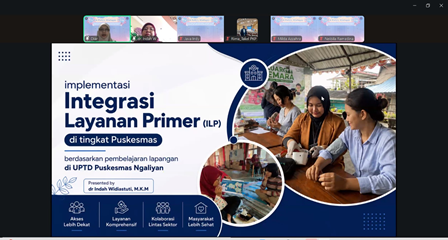
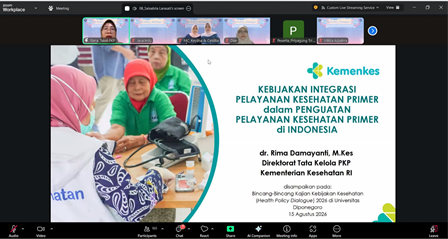
In her presentation, Dr. Rima Damayanti, M.Kes., explained that ILP aims to create primary health care services that are more comprehensive, responsive, and affordable. ILP shifts the service approach from being program-based to cluster-based, tailoring services to the specific needs of the community across the entire life cycle. A key point of discussion was how the ILP policy could be effectively translated into practice at the level of Community Health Centers (Puskesmas) and Integrated Health Posts (Posyandu). Dr. Rima noted that the Ministry of Health launched ILP technical guidelines in 2023 and has been conducting tiered coordination and monitoring with regional authorities. Capacity building is also being pursued through the appointment of facilitators across all provinces. Regarding field implementation, Dr. Indah Widiastuti, M.K.M., shared the experience of the Ngaliyan Community Health Center (UPTD Puskesmas Ngaliyan) in adopting a cluster-based organizational structure. ILP implementation at the center is organized into five service clusters: management; maternal and child health; adult and elderly health; communicable disease control and environmental health; and cross-cluster services.
Discussions on cross-sector coordination further highlighted the complexities involved in ILP implementation. According to Dr. Rima, while each sector already makes its own contribution, the success of collaboration hinges heavily on the communication and advocacy strategies employed. At the Community Health Center (Puskesmas) level, cross-sectoral support is considered adequate within the respective scopes of each sector, although budgetary support still falls short of expectations. Through these activities, students are expected to act as collaborators, drivers, and connectors in optimizing the Integrated Primary Care (ILP) model. (Calon Forum AKK 2027)